Travis DorsoCustomer Success & AI Strategy

South Florida · Open to New Roles

Travis Dorso

I own enterprise customer relationships, lead complex implementations, and drive production issues through resolution.

Over 15 years in communications technology, I’ve managed adoption, renewals, and expansion; led AI and telephony rollouts; and coordinated engineering and operations during customer escalations. I help customers decide where AI fits their operations, what the application needs to deliver, and which changes deserve priority. I connect workflow design, integrations, production performance, and financial evaluation to recommendations for adoption and investment.

Customer Success · Technical Account Management · Implementation · Value Realization

Black-and-white portrait of Travis
$10M to $17M

Annual enterprise portfolio revenue

Sr. Customer Success Manager · 2024–2026
110–125%

Net revenue retention

Maintained during that portfolio’s growth
15 Years

Customer and operational experience

Support, delivery, account ownership, and AI

01 / Scope of Work

Customer Ownership
and Applied AI Strategy

I connect customer goals to application capabilities, delivery priorities, and operational requirements. My work spans enterprise account ownership, implementation, production resolution, and recommendations on how to improve and expand the service.

Enterprise Customer Success

Enterprise Account Ownership

I managed onboarding, adoption, account reviews, renewals, and expansion. As a senior CSM, I grew annual portfolio revenue from $10M to $17M while maintaining 110–125% net revenue retention. I supported annual purchase orders and translated technical issues into business impact for customer leadership.

Implementation & Project Delivery

Implementation and Project Leadership

I led AI and telephony implementations, including batch migrations during maintenance windows, number porting, site-level user permissions, and SMS compliance registration. I set delivery priorities across accounts, balancing production fixes with new projects, and led customer onboarding and training.

Technical Account Management

Production Escalations and Resolution

I coordinated engineering, operations, and implementation teams during escalations, kept customers informed, and followed through on postmortems after outages. My work included investigating failure patterns, documenting customer impact, defining corrective actions, and verifying fixes against live traffic.

AI Success & Value Realization

AI Application Strategy and Value

I evaluated how voice and SMS applications served customer workflows, identified unmet demand and constraints, and recommended what to improve or automate next. I connected application behavior, integrations, business rules, adoption, and ROI models to executive decisions about performance and investment.

02 / Selected Case Studies

Application Decisions
and Customer Outcomes

These engagements show how I connect business needs to application improvements, release priorities, and customer decisions. Production evidence supports the recommendations and verifies what changed. Customer identities and confidential figures are withheld.

01Logistics
Inbound Voice

Root-Cause Investigation & Account Expansion

Addressing Integration Gaps to Support Broader Use

A logistics company’s voice agent handled delivery tracking and scheduling across multiple retailers, but containment had stayed flat for most of a year. I evaluated the order-lookup workflow and its dependencies to identify what was limiting the application’s usefulness and prioritize changes with the customer and engineering teams.

My Responsibility

Application assessment, customer alignment, improvement priorities, engineering recommendations, and verification of production changes.

Outcome

Engineering Action and Account Expansion

My findings became prioritized Jira stories and supported a new deal with a second division of the customer. I owned the investigation, recommendations, and verification; engineering implemented the fixes and sales owned the deal.

Read the Case StudyClose the Case Study

The Customer Problem

A logistics company used an inbound voice agent to handle delivery tracking and scheduling for purchases made through multiple retailers. Containment had stayed flat for most of a year. The customer needed to understand whether failures originated in the agent, its own systems, or the reporting before deciding what to change.

The Evidence

I traced caller-to-order match rates across the year and separated the results by retail client. One client’s match rate fell to zero while another’s dropped sharply. I checked the timing against several independent records and confirmed the finding with the customer’s head of customer experience.

Recommendations and Follow-Through

The customer’s coverage tables had fallen out of sync. Failed order lookups left the agent unable to complete the request. I developed recommendations with supporting counts, including two changes the customer had already requested in writing. Those recommendations became Jira stories. I also owned verification of the fix against live traffic.

The investigation contributed to expansion into a second division. Engineering owned the fixes; sales owned the resulting deal.

02Dental Operations
Inbound Voice

Use-Case Priorities & Release Oversight

Guiding the Expansion of Appointment Self-Service

A dental support organization was expanding its voice agent from after-hours message capture to business-hours overflow and live appointment changes. I connected patient demand to capability recommendations, evaluated integration and scheduling constraints, and guided customer discussions about release performance and the work needed to support broader use.

My Responsibility

Use-case recommendations, release assessment, integration and business-rule analysis, performance measurement, and customer guidance through the transition to steady-state operations.

Outcome

Clearer Performance and a Basis for Broader Use

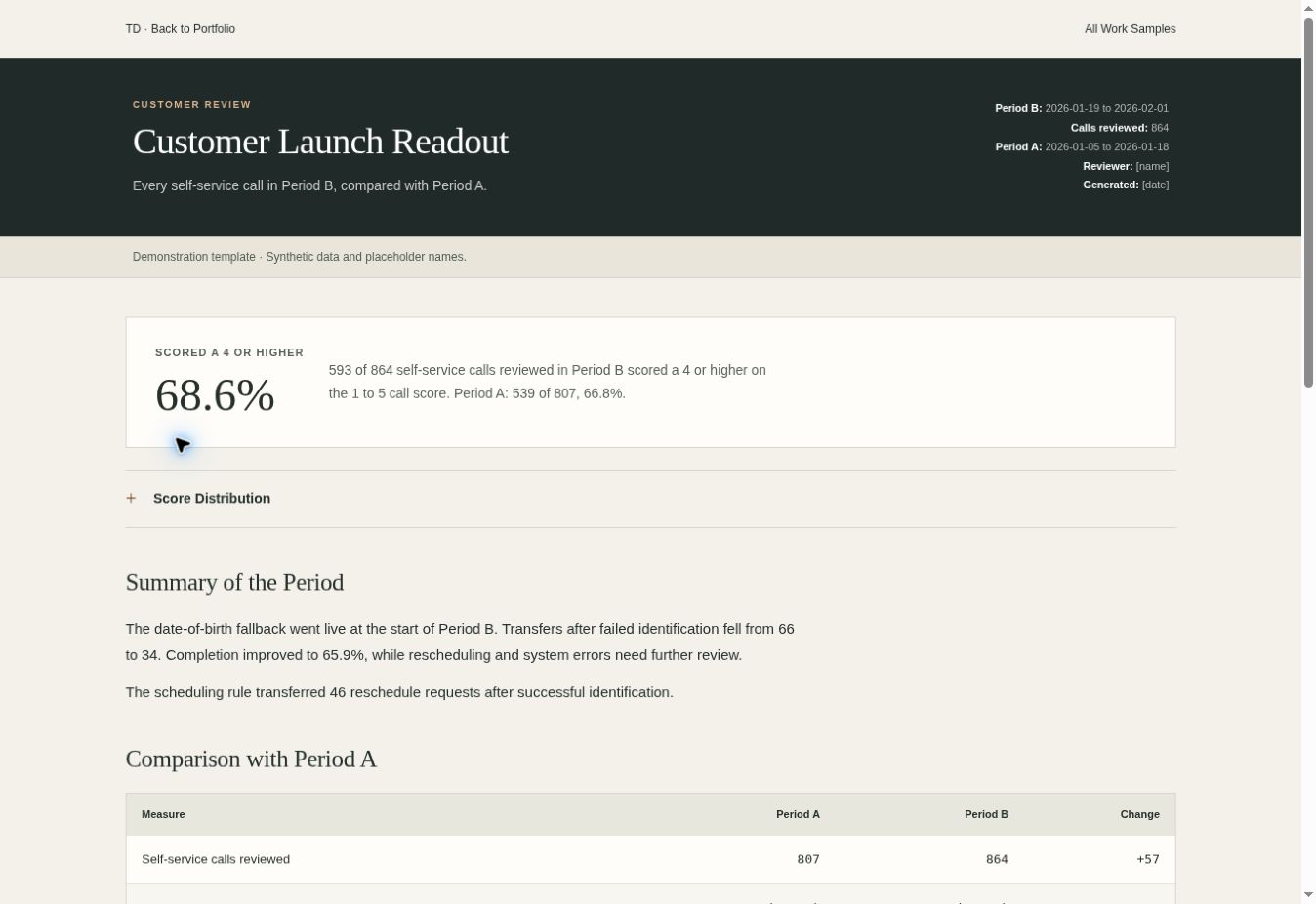
My assessment clarified where the application supported patient needs and where office intervention or further development was required. Demand analysis identified opportunities to support more appointment changes. As capabilities expanded, I verified live cancellations and rescheduling, including patients choosing a new appointment instead of canceling.

Read the Case StudyClose the Case Study

Setting Priorities From Patient Demand

The initial agent handled a limited set of self-service tasks and captured messages for office staff. I classified patient requests to identify where additional capabilities would address the most demand. Appointment changes stood out, giving my recommendations for cancellation and rescheduling a basis in actual calls.

Giving the Customer an Accurate Account

I reviewed calls, ticket records, and reported outcomes across releases. Successful ticket delivery did not always mean the office received accurate information, and some completion flags did not match the patient’s actual outcome. I exposed incorrect patient classifications and premature completion flags, documented the affected calls, and recommended corrections. My readouts brought these gaps into customer discussions alongside what was working, giving the customer a clearer basis for setting priorities.

Finding Why Appointment Changes Failed

As live cancellation and rescheduling became available, I traced incomplete requests through patient identification, appointment lookup, scheduling eligibility, available times, and patient choice. I separated integration failures from business rules and cases where patients declined the available options. That gave engineering and the customer specific causes to address.

Identifying Opportunities for Broader Use

I connected unmet appointment demand to the capabilities and integration requirements needed to serve it. This gave the customer and internal teams a concrete basis for discussing broader use of the service. I measured completion against eligible requests and assessed the caller experience separately, so those discussions reflected both what the service could support and where it still fell short.

As the service expanded, my production reviews confirmed live cancellations, successful rescheduling, and patients choosing a new time instead of canceling. I continued documenting unresolved failures and remaining office follow-up, keeping the customer informed about progress and the work still needed.

Related Demonstration · Synthetic DataCustomer Launch Readout
03Healthcare
Outbound Voice

Technology Evaluation & Executive Decision Support

Evaluating AI for Outbound Connections

A healthcare provider was replacing its answering-machine detection system with AI. Leadership needed to know whether the change improved connections. I designed an evaluation of the technology change so leadership could assess its value, accounting for campaign differences and the limits of the available evidence.

My Responsibility

Evaluation criteria, comparative assessment, interpretation of business results, and executive guidance on what the evidence supported.

Outcome

Higher Connection Rates Across Two Weeks

The switched campaign’s connection rate improved across two weeks while comparison campaigns remained stable. I delivered the assessment and supporting calculations to leadership and the customer, documenting sample-size limits and new call lists as a competing explanation.

Read the Case StudyClose the Case Study

The Question

A healthcare provider was replacing Asterisk answering-machine detection with AI detection in batches. Leadership needed to know whether the switch improved connections. New call lists went live at the same time, making attribution difficult. Recording was prohibited, so the investigation depended on call dispositions.

The Method

I defined connection rate as Transferred ÷ (Live Answer + Transferred). I compared switched campaigns with campaigns still using Asterisk during the same weeks and stated what each campaign’s call volume could reliably show.

The Result and Its Limits

The improvement persisted across two weeks in the switched campaign. Two smaller campaigns had too few calls to support a conclusion. The new lists remained a competing explanation, so I reported a positive indicator with that limitation clearly stated. The available evidence did not establish causation.

I delivered a formula-based calculations workbook, methodology document, internal readout, customer email, and executive slide. Engineering and the customer owned the cutover.

Related Demonstration · Synthetic DataPeriod Comparison
04Healthcare
Inbound Voice

Application Design & Operational Readiness

Identifying Barriers to Patient Self-Service

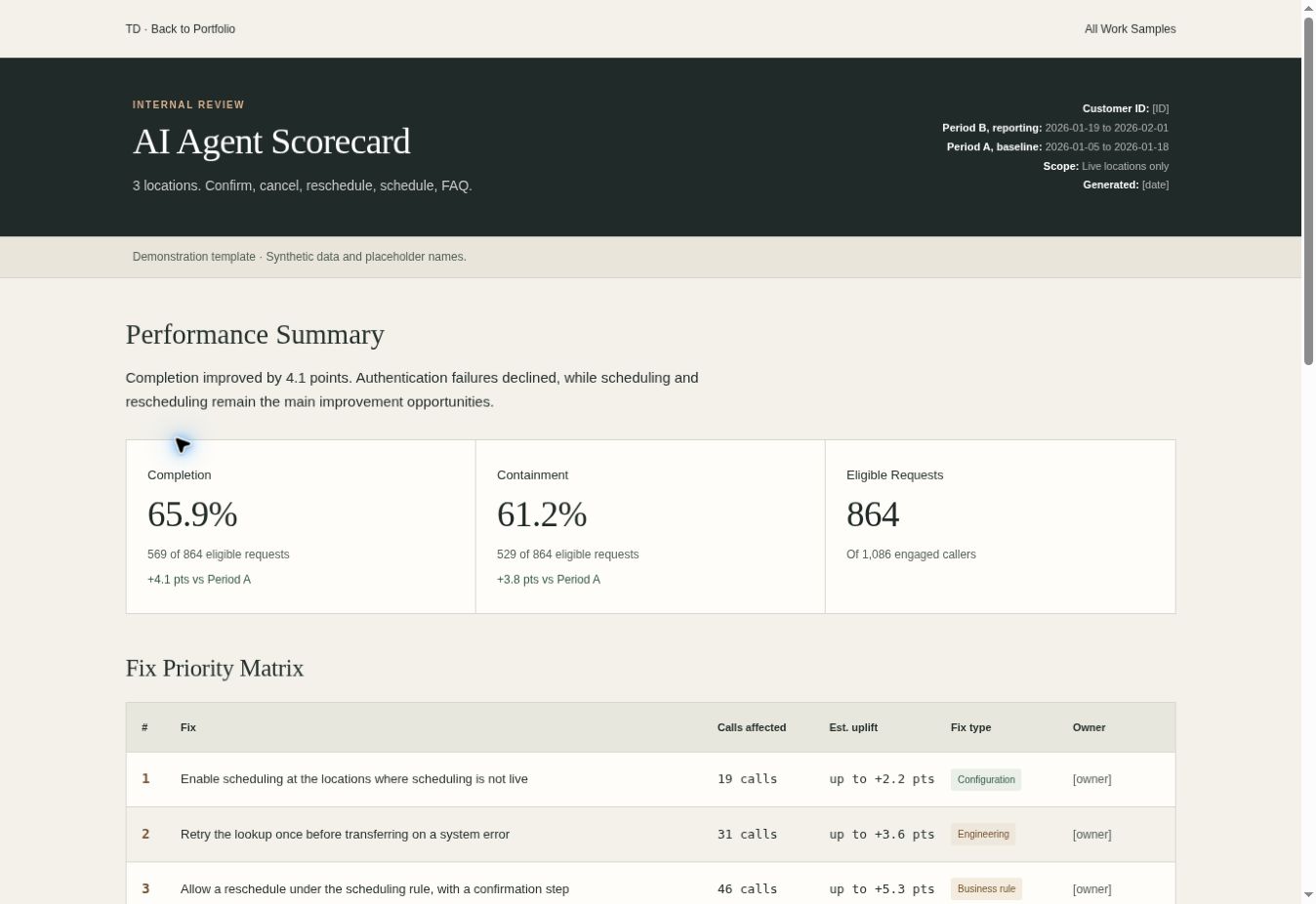
A medical group’s voice agent handled appointment confirmation, cancellation, and rescheduling. Patients were encountering verification and appointment-lookup failures, while reporting obscured the causes of transfers. I assessed the scheduling workflow across the application, integrations, carrier services, and customer rules, corrected performance measurement, and recommended changes to improve self-service.

My Responsibility

Workflow assessment, application design recommendations, customer decision support, measurement corrections, and coordination of findings across engineering, QA, analytics, and carrier investigations.

Outcome

Corrected Reporting and Targeted Recommendations

The corrected calculation resolved the containment reporting issue. I also documented the verification, appointment-lookup, and caller-ID problems and routed recommendations to the responsible teams. The redesign and carrier fix remained open when my assignment ended.

Read the Case StudyClose the Case Study

The Customer Problem and Review

A medical group had launched an agent for appointment confirmation, cancellation, and rescheduling. I evaluated whether the application and supporting systems could complete those workflows under the customer’s operating rules. Production records and experience scoring helped isolate design gaps, integration problems, and misleading reporting.

Where Requests Failed

When a phone number did not identify a patient, the agent requested another number and transferred. It offered no date-of-birth fallback. Some identified patients still could not complete a request because appointments had been moved or canceled, or were outside the agent’s permitted scope. Customer eligibility rules and transfer timing also affected the results.

A separate carrier issue stripped caller ID before calls arrived, contributing to verification failures. In reporting, a transfer flag could not distinguish required transfers from requests for a person. A change in intent tagging also invalidated a two-week comparison.

What the Work Produced

I sent daily internal and customer readouts, routed reporting corrections to analytics, experience issues to QA, and design improvements to engineering with supporting counts. The caller-ID finding went to a carrier investigation.

Measurement Correction and Remaining Work

I measured containment against eligible self-service requests and treated rescheduling transfers according to the configured business rules. The redesign and carrier fix remained open when my assignment ended.

This corrected the containment calculation so the reported rate reflected eligible self-service requests and the configured transfer rules.

Related Demonstration · Synthetic DataCall-Scoring Rubric

Additional Engagements

Recruiting by SMS

I assessed how an SMS recruiting application supported the hiring workflow, from automated screening to recruiter follow-up and job availability. I linked screening activity to application records and tracked applicant progress over several months. I identified changes in disqualification criteria, applicants waiting on recruiters, and applications reaching jobs that had already closed. The analysis separated screening decisions from follow-up delays and job-availability issues, giving the customer specific areas to address: review screening rules against hiring requirements, prioritize applicants awaiting a response, and align screening with open roles. These opportunities could reduce avoidable delays and wasted effort while giving applicants a clearer path through the recruiting process.

03 / Value Realization

AI Strategy
and Value Realization

I help customers evaluate where AI can serve their operations, what prevents the application from delivering value, and what to improve next. Scorecards, review methods, and financial models support those decisions.

Use Cases and Priorities

I connect customer demand to application capabilities and identify the workflow, integration, and business-rule changes needed to support broader use. Recommendations distinguish current limitations from opportunities worth evaluating.

Application Performance and Experience

I evaluate whether the application completes the intended work and provides a usable customer experience. I validate the measures behind that assessment so decisions reflect actual outcomes, with technical evidence available for investigation.

Recommendations and Accountability

I translate findings into engineering stories, QA scenarios, customer decisions, and carrier investigations. Readouts identify the issue, business impact, responsible team, and evidence needed to verify resolution.

Adoption and Financial Value

I measured agent-assist usage, acceptance of AI-written summaries, handle time, and after-call work against pre-launch baselines. I built ROI, payback, and break-even models with explicit assumptions to support customer investment decisions.

Release Oversight and Verification

My responsibilities have included cutover and regression testing, release tickets and notes, daily launch reviews, executive recommendations, and verification on live traffic.

A Working Example

Containment and Completion Calculator

In this framework, containment is measured against requests the agent is built to handle. Change the counts to see how completion and containment differ.

Illustrative data. No customer results.

60%Containment
70%Completion

100 eligible self-service requests

Containment = completed without transfer ÷ eligible requests.
Completion = all completed requests ÷ eligible requests.

04 / Work Samples

Decision Support
and Working Methods

Seven demonstration templates show how I turn application evidence into release priorities, operational recommendations, and customer decisions. All figures are synthetic; customer names, locations, and ticket IDs are placeholders.

Complete Work-Sample Collection

05 / Experience

15 Years in Customer Success
and Technical Delivery

At IntelePeer, I progressed from frontline support and account management to enterprise customer ownership, AI application evaluation, and value realization.

2026

AI Value Realization Analyst

Evaluated enterprise voice and SMS applications across healthcare, logistics, senior living, and insurance. Connected customer needs, workflow constraints, and production evidence to application improvements, automation recommendations, and investment decisions.

2024–2026

Sr. Customer Success Manager

Grew annual enterprise portfolio revenue from $10M to $17M while maintaining 110–125% net revenue retention. Owned adoption, escalations, optimization, renewals, and expansion. Led AI and telephony implementations, production incident coordination, and customer communication.

2018–2024

Customer Success Manager

Grew annual portfolio revenue from $5.5M to $8M. Managed onboarding, adoption, go-lives, production escalations, retention, and expansion, earning promotion to the senior role.

2014–2018

Account Manager / Project Manager

Managed a $1.1M–$1.2M client portfolio while delivering CPaaS and SaaS projects. Led demonstrations, proposals, onboarding, customer training, and account reviews. Trained new hires, conducted quarterly customer site visits, and translated customer feedback into product improvements.

2012–2014

Help Desk / Product Support Lead

Owned frontline troubleshooting and customer communication from first report through resolution. Built knowledge content and worked with Product and Development on customer-driven improvements.

2011–2012

Transcriber · Part-Time

First role at IntelePeer, before moving into product support and customer-facing delivery.

Tools Used in the Work

Claude · Sigma · Snowflake · Jira

Education & Training

B.B.A., Sports Administration — Saint Thomas University
Customer Success Manager Certified Professional II — Gainsight
Certified Scrum Master (CSM)

06 / Contact

Get in Touch

I’m interested in roles that combine customer ownership, technical delivery, and measurable business results. That includes enterprise or client success, technical account management, implementation and project management, customer experience, applied AI strategy, and value realization. The responsibilities matter more to me than the title. Based in South Florida.

tntdorso@icloud.com